Joni 1971:
This is a digital working book for Joni 1971.
This project is being developed with the support of Banff Centre for Arts and Creativity and a pilot route through festivals, and not for profit venues.
It is shared for private evaluation only. Please do not forward.
- Non exclusive licence.
- We are not seeking exclusivity of any kind.
- Live performance only.
- Three year term. Worldwide.
- No Joni Mitchell master recordings.
- Title use only. No likeness requested at this stage.
Development documentary
A fifteen minute documentary capturing the work created during the Banff residency in February 2026, featuring interviews with the creators and producers of the project, alongside short extracts that demonstrate the form, the headphone experience, and Lisa’s performance. It is intended for private evaluation by invited presenters and the rights holders. Not for public release or onward sharing
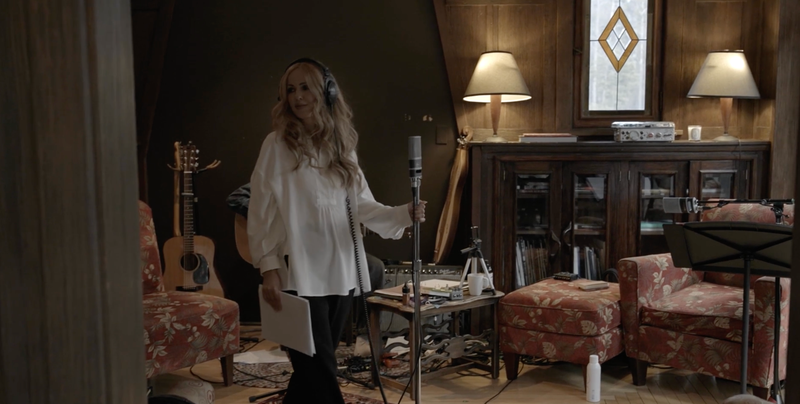
The piece combines live performance of Joni Mitchell’s songs with spoken text that draws on her interviews and biographical material, re phrased and shaped for the stage.
The audience listens on wireless headphones. The sound is mixed live during the performance.
Key facts
Running time: 80 minutes
Audience: three sides
Scale: up to 450 to 500
Performance: live, with live mixing
There is also acoustic sound in the room from voice, guitar, and the upright piano shell. The primary experience is through the headphones.
Key facts
Headphones: silent disco style, likely open backed
Mix: stereo, shared feed
Configuration: three sides
Nothing modern is visible. Modern equipment is concealed under the deck or housed inside period shells and cases.
The sound language marks different modes. Tape rolling and talkback indicate studio reality. Interior passages use a different sound treatment.
Key facts
Setting: A and M Studio C, 1971
Design rule: no visible contemporary technology
Motifs: tape, talkback, recording sign
Key facts
Deck: 16 foot square, 400mm high
Primary configuration: three sides
Proscenium version: on stage audience around apron
Spoken passages have more flexibility in mic perspective and distance.
All audio is created for this production. No master recordings are used. Any additional sound material, if used, is newly created and delivered within the live performance.
Headphone failure plan
FOH holds charged spares and swaps individual headsets at the next natural break.A backup transmitter feed can be switched in immediately if the primary feed drops.If there is a wider system failure, the show continues using in room acoustic sound and a simple house PA mix while the headset system stabilises.If stability cannot be restored quickly, the session is paused, the audience are informed, and the show resumes once a reliable listening method is restored.
Key facts
Mix: stereo, one feed for all
Operation: onstage mixer with FOH monitoring
Audio: live only, no masters
The text is written by Graham McLaren. It is based on research across long form interviews, documentaries, and biographies.
It uses Joni Mitchell’s words as source material, but the spoken text is re phrased and shaped for the stage, rather than presented as verbatim quotation.The draft combines three kinds of material:
- Live performance of songs
- Studio talk and working process, including talkback and session notes
- Interior passages, marked through sound treatment rather than changes of location
Full performances at this stage.
Spoken layering is under exploration.
Lyrics are not altered.
Both Sides Now
Cactus Tree
I Had a King
Chelsea Morning
Big Yellow Taxi
Woodstock
For Free
Conversation
Little Green
All I Want
My Old Man
Blue
California
This Flight Tonight
A Case of You
River
The current draft includes a short piano underscore moment labelled “Whilst Piano plays The Last Time I Saw Richard” during an onstage writing action. This will be clarified as underscore only, or replaced with non specific piano underscore language in the next draft.
Key facts
Songs: 16
Performance: live
Lead Perfomer: Lisa Lambe
Writer, director, designer: Graham McLaren
Sound design: Nick Sagar
Piano: Vincent Lynch
Guitar: Jake Curran
Lighting design: to be confirmed
Onstage mixer: to be confirmed
Production sound: to be confirmed
Production manager: to be confirmed
Stage manager: to be confirmed
Team
Graham Mclaren
Writer/Director/Designer
Graham McLaren is an internationally acclaimed Scottish theatre maker with more than 30 years’ experience creating award winning work across four continents. He has led two national theatres as Artistic Director of the Abbey Theatre, Ireland’s National Theatre, and as Associate Director of the National Theatre of Scotland, and founded the internationally acclaimed, Theatre Babel. He has served as Artistic Director of Perth Theatre, Scotland and as Associate Director for Necessary Angel, Canada. His productions include large scale international tours, festival commissions, and innovative re imaginings of classic and contemporary texts. Graham’s work has been presented at leading venues and festivals worldwide, including Edinburgh International Festival, Sydney Opera House, and Luminato Festival Toronto.
Nick Sagar
Sound Designer
Nick Sagar is an internationally recognised sound designer and composer for theatre and live arts. He is a long standing collaborator of the late Robert Wilson, with sound design credits including Letter to a Man, Jungle Book, Mary Said What She Said, and I Was Sitting on My Patio This Guy Appeared I Thought I Was Hallucinating. His work has been presented by leading institutions including Théâtre de la Ville Paris and Manchester International Festival.
Lisa Lambe
Lead Perfomer
Lisa Lambe is one of Ireland’s most acclaimed actors, singers, and folklorists. She was central to the international success of Celtic Woman, earning Emmy and Grammy nominations and six consecutive Billboard World Artist of the Year awards. On stage, she has played leading roles at the Abbey Theatre and The Gate Theatre in Dublin, in works by Paul Muldoon, Edna O’Brien, and Brian Friel, and won recent acclaim in the leading role for London’s National Theatre. Internationally, she has performed at Radio City Music Hall New York, Red Rocks Colorado, Glastonbury, and Irish Arts Centres in New York, Paris, and London. The Irish Times describes her as “the finest singer and actor of her generation.”